
Precision Injection Molding Solutions for EV Pipe Joints
CNMOULDING • High-Tolerance Automotive Tooling & Molding Since 1997 • Shanghai Plant
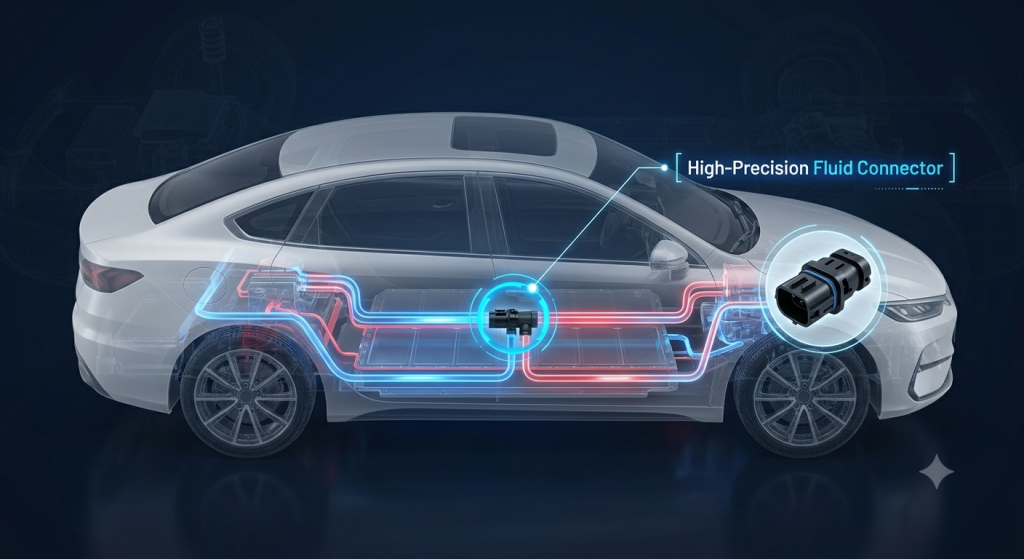
In the rapidly evolving Electric Vehicle (EV) ecosystem, the Thermal Management System (TMS) dictates battery lifecycle, charging speed, and powertrain safety. As a long-term, direct tooling and series-production vendor for BYD (Build Your Dreams), CNMOULDING bridges the gap between complex engineering designs and high-volume, defect-free production. Based in our advanced Shanghai plant, we specialize in multi-cavity injection molds and specialized molding for high-performance EV coolant pipe joints, quick connectors, and multi-way fluid distribution valves.
| End Client: | BYD EV Platforms (Series Mass Production) | Molding Volume: | Annualized 1.5 Million+ Units |
| Component Name: | Multi-Way Coolant Distribution Joint | Mold Layout: | 1×4 Cavities, Fully Automatic Inproduction |
| Resin Compound: | PA66-GF30 (Hydrolysis-Resistant, Heat-Stabilized Automotive Grade) | Critical Tolerance: | Core Plug Roundness ≤ 0.03 mm |
1. Technical Breakdown: Overcoming OEM-Level Failures
Engineering components for BYD’s high-voltage e-Platform requires surviving rigorous Validation Testing (DVT/PVT). Traditional molding processes often fail to meet the tight baseline standards. Here is how CNMOULDING delivers validated, failure-free components right from the tool kinematics:
A. Eliminating Weld Line Structural Fragility
The Challenge: Fluid distribution joints have complex, hollow internal chambers. When the glass-fiber reinforced PA66-GF30 melt splits around the core pins forming these inner passages, it reunites to create a weld line. Under BYD’s thermal fluid shock testing (-40°C to 125°C cycling for 500+ hours) and continuous operating pressures of 0.3 MPa, these weld lines are prime targets for notch-stress failure and coolant micro-leakage due to poor glass fiber entanglement.
Our Proven Solution: CNMOULDING’s engineering desk utilizes advanced CAE Moldflow tracking to manipulate the melt front velocity. In the 1×4 cavity tool built for BYD, we integrated a Sequential Hot Runner Valve Gate System combined with dedicated over-flow cold slug tabs. By precisely controlling the opening sequences of each valve pin, we successfully relocated the unavoidable weld lines away from high-stress fluid-dynamic cross-sections into non-structural zones. This engineering approach guaranteed a weld-line knit factor exceeding 88% of the bulk material strength, successfully passing BYD’s 1.5 MPa burst pressure qualification.
B. Achieving Zero-Leak Roundness & Parting-Line Flash Control
The Challenge: The mating interface for the quick connector sleeve demands an inner/outer diameter roundness tolerance within ≤ 0.03 mm to maintain strict O-ring compression. Due to the high glass-fiber loading, anisotropic shrinkage leads to post-molding warpage. Furthermore, any parting-line mismatch or flash exceeding 0.02 mm compromises the sealing hermeticity, leading to glycol seepage inside high-voltage battery enclosures.
Our Proven Solution:
The core inserts and slide blocks of our multi-cavity tools are machined using premium tool steel (Assab/Groditz 1.2344, HRC 52-54) subjected to triple-stage sub-zero cryogenic stabilization to eliminate residual machining stresses. Tool fabrication is executed on ultra-precision high-speed 5-axis CNCs (machining accuracy locked at ±0.003 mm). To combat shrinkage variation, we engineered conformal cooling water lines within the sliding cores, maintaining a mold cavity surface delta temperature of ΔT ≤ 3°C. This keeps the mating sleeve circularity strictly within ≤ 0.03 mm throughout mass production runs.
2. Manufacturing Control & Quality Matrices
To support sustained high-volume programs like BYD’s series logistics, our automated Shanghai cell operates under standard high-level technical parameters:
| Control Metric | CNMOULDING Production Execution Standard |
|---|---|
| Material Integrity | Automated desiccant dehumidifying/drying (dew point ≤ -40°C) to prevent moisture-induced PA66 hydrolysis degradation during processing. |
| Flash / Burr Threshold | Strict parting-line shut-off clearance kept at ≤ 0.01 mm, maintaining flash height at a zero-visual level (≤ 0.015 mm maximum). |
| Cavity Balance Equilibrium | Hot runner manifold balanced at ≥ 98.5% filling uniformity across all 4 cavities, monitored by in-cavity pressure transducers. |
| Post-Molding Automation | Integrated 6-axis servo robots perform gentle extraction, part isolation by cavity, and transfer to inline automated vision check stations. |
3. Direct OEM Partner Benefits: Why Tier 1s Choose CNMOULDING
- Authentic BYD Supply Chain Track Record: We don’t just build tools; we understand the rigorous verification standards, engineering change notice (ECN) speeds, and PPAP Level 3 documentation demands of major EV OEMs.
- Comprehensive Lab In-House Verification: Equipped to assist your project engineering teams with initial pneumatic pressure drop leak testing (leakage threshold ≤ 8 mm³/min under 0.6 MPa continuous pressure), coordinate measuring machine (CMM) dimensional reports, and cross-sectional fiber mapping.
- Flawless System Adherence: Operating under rigorous IATF 16949 automotive quality governance with complete traceability from raw resin batch numbers to final production lot stamps.
4. Engage with Our Shanghai Application Engineering Team
Whether you are local or an overseas Tier 1 integrator seeking a reliable, high-performance Chinese production partner, CNMOULDING provides the localized efficiency and global standards required to protect your project timelines. Don’t risk line-downs or field recalls over minor joint leaks.
Send your native 3D CAD files (STEP/IGS) and Statement of Requirements (SOR/SOW) directly to our technical desk. Our engineers will reply within 24 hours with a comprehensive Production-Ready DFM Report, featuring initial gate location optimization, Moldflow fill/warp analyses, and proposed cooling layout drawings.
